Is a Practical Digital Marketing Course Better Than Learning From YouTube?
Compare YouTube learning with a practical digital marketing course. Discover the benefits of hands-on training, AI tools, projects, and expert guidance.
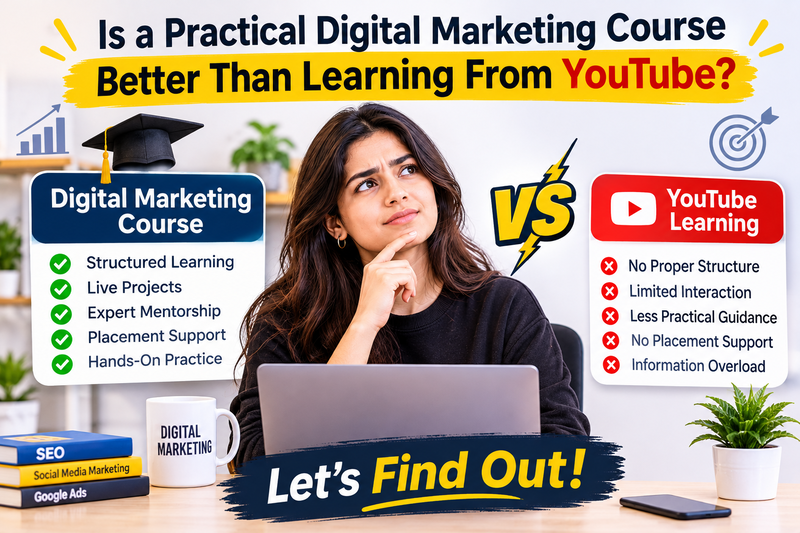
Learning digital marketing has become easier than ever. You can find thousands of free YouTube videos explaining SEO, social media marketing, Google Ads, content creation, email marketing, and other important skills. Many beginners start their learning journey on YouTube because it is free, flexible, and accessible from anywhere.
But there is one important question: Is watching YouTube videos enough to build a successful career in digital marketing, or is joining a practical digital marketing course a better option?
The answer depends on your learning goals, experience, and the kind of career you want to build.
YouTube is an excellent platform for understanding digital marketing concepts. However, when it comes to gaining practical experience, working on real campaigns, receiving expert feedback, and preparing for a job, structured practical training can offer several advantages.
Let's compare both learning methods and understand which option can help you develop job-ready digital marketing skills.
1. Learning Digital Marketing From YouTube: What Are the Benefits?
YouTube is one of the most popular platforms for learning new skills. You can find tutorials from experienced digital marketers, industry professionals, and educators who explain different marketing techniques.
For beginners, it is a convenient way to understand how digital marketing works.
Advantages of Learning From YouTube
Free Learning Resources
Most digital marketing tutorials on YouTube are available for free. You do not need to pay course fees to understand basic concepts such as SEO, keyword research, social media management, or Google Ads.
Learn at Your Own Speed
You can pause, replay, and watch lessons whenever you have time. This flexibility is helpful for students, working professionals, and business owners.
Access to Different Experts
Different creators explain the same topic in different ways. You can explore multiple teaching styles and learn various approaches to online marketing.
Explore Specific Digital Marketing Skills
You can find individual tutorials on topics such as:
Search engine optimization (SEO)
Social media marketing
Google Ads and paid advertising
Website development basics
Keyword research
Content marketing
Email marketing
Google Analytics
AI tools for marketing
These resources make YouTube a useful starting point for anyone interested in digital marketing.
What Are the Limitations of YouTube Learning?
Although YouTube offers valuable information, learning entirely from videos can create some challenges.
1. No Structured Learning Path
You may learn SEO today, Google Ads tomorrow, and social media marketing next week without understanding how these skills connect. A structured learning plan helps you understand which topics to learn first and how to apply them together.
2. Limited Personal Guidance
When you face a problem while creating a website, setting up an advertising campaign, or analysing website traffic, you may not receive personalised feedback.
3. Less Practical Accountability
Watching someone create a marketing campaign is different from creating one yourself. Without regular assignments and deadlines, beginners may keep watching tutorials without developing practical skills.
4. Information Can Become Outdated
Digital marketing platforms frequently introduce new features, tools, and policies. Some older tutorials may no longer reflect current practices, so learners need to check the latest official documentation and platform updates.
YouTube is useful for learning individual concepts, but you need a practical approach to turn that knowledge into professional skills.
2. What Makes a Practical Digital Marketing Course Different?
A practical digital marketing course is designed to teach you how to use marketing knowledge in real situations rather than only explaining theoretical concepts.
Instead of simply watching videos, you learn through guided exercises, assignments, projects, campaign planning, and hands-on activities.
A well-designed course combines theoretical knowledge with practical implementation.
For example, you might not only learn what SEO means but also practise:
Finding keywords for a website.
Analysing search intent.
Optimising website pages.
Writing SEO-friendly content.
Understanding Google Search Console.
Tracking website performance.
Identifying opportunities to improve organic traffic.
Similarly, while learning paid advertising, you can practise campaign planning, audience research, budget allocation, ad copywriting, and performance analysis through guided exercises or supervised projects.
Major Benefits of Practical Digital Marketing Training
Hands-On Experience
You work with digital marketing tools and apply your knowledge through practical activities. This helps you understand how marketing strategies work outside a classroom.
Step-by-Step Learning
A structured curriculum takes you from basic concepts to advanced techniques. You can build your knowledge gradually instead of jumping between unrelated tutorials.
Expert Guidance and Feedback
Experienced trainers can review your work, identify mistakes, and suggest improvements. This feedback can help you understand concepts that may be difficult to learn independently.
Industry-Relevant Projects
Practical assignments can help you understand how businesses use digital marketing to attract customers, generate leads, increase website traffic, and improve brand visibility.
Career Preparation
Projects, campaign reports, and a portfolio of completed work can help you demonstrate your skills during interviews or while approaching potential clients.
However, the quality of training matters. Not every course offers meaningful practical experience. Before enrolling, check the curriculum, trainers, project work, and learning support.
3. Practical Digital Marketing Course vs YouTube: Which Is Better?
Both learning methods have advantages, but they serve different purposes.
Here are the main differences:
Learning Structure
YouTube provides individual videos on different topics. You need to decide what to learn and how to organise your learning journey.
A practical course generally follows a planned curriculum that covers important digital marketing skills in a logical order.
Better option for structured learning: A practical digital marketing course.
Practical Training
YouTube tutorials show you how to perform different tasks, but you must find opportunities to practise independently.
A practical course may include assignments, guided projects, campaign exercises, and trainer feedback.
Better option for guided practice: A course that includes hands-on training.
Personal Mentorship
YouTube does not usually provide individual mentorship. You can ask questions in comments, but personal guidance is not guaranteed.
A training institute may provide opportunities to interact with trainers, discuss doubts, and improve your work.
Better option for personal guidance: A course with accessible trainers and regular feedback.
Learning Flexibility
YouTube allows you to study whenever you want. You can choose your own schedule and spend more time on difficult topics.
A classroom or scheduled online course may have fixed sessions, although some institutes also provide flexible learning options.
Better option for complete schedule flexibility: YouTube.
Learning Cost
YouTube is generally free, making it suitable for beginners who want to explore digital marketing without making an initial financial commitment.
A professional course requires an investment, but it may include structured lessons, practical projects, mentorship, learning resources, and career support.
Better option for a limited budget: YouTube.
Career Preparation
YouTube can help you gain knowledge, but building a portfolio and preparing for professional work requires independent effort.
A practical course with relevant projects, feedback, and career guidance can provide a more organised route towards job readiness.
Better option for guided career preparation: A quality practical course.
4. Why Practical Experience Matters More Than Just Watching Tutorials
Imagine that you have watched 20 YouTube videos about search engine optimization. You understand what keywords are, how backlinks work, and why website content matters.
But can you independently analyse a website and identify why its pages are not ranking?
Can you perform keyword research, optimise website content, check technical SEO issues, and prepare a performance report?
This is where practical experience becomes important.
Employers and clients often need people who can apply digital marketing knowledge to solve business problems.
Practical training helps you develop skills such as:
Problem-solving: Identifying marketing problems and finding suitable solutions.
Research skills: Understanding audiences, competitors, keywords, and market opportunities.
Campaign management: Planning and monitoring digital marketing campaigns.
Data analysis: Understanding traffic, engagement, conversions, and advertising performance.
Content creation: Developing content for websites, social media, and advertising platforms.
Communication: Presenting marketing strategies and explaining campaign results.
The more you practise, the more comfortable you become with applying your knowledge to different marketing situations.
Remember, completing a course alone does not guarantee employment. Your actual skills, project experience, communication, and ability to deliver results also matter.
5. Skills You Should Learn in a Practical Digital Marketing Course
Before choosing any training programme, check whether it teaches the major areas of modern digital marketing.
A good curriculum should cover both foundational knowledge and practical implementation.
Search Engine Optimization (SEO)
SEO helps websites improve their visibility in search engine results.
You should learn keyword research, on-page SEO, technical SEO basics, content optimisation, link-building fundamentals, search intent, and website performance analysis.
Social Media Marketing
Social media platforms help businesses connect with audiences and promote their products or services.
You should understand content planning, social media strategy, audience engagement, creative development, and performance tracking.
Google Ads and Paid Advertising
Paid advertising helps businesses reach targeted audiences through online campaigns.
A useful training programme should explain campaign objectives, keyword targeting, audience selection, ad copy, budgeting, conversion tracking, and campaign optimisation.
Content Marketing
Content marketing focuses on creating useful information that attracts and engages potential customers.
Learn how to plan blog topics, write website content, develop social media posts, and create content based on audience needs and search intent.
Website and Analytics
Understanding websites and analytics is important for measuring marketing performance.
You should learn the basics of landing pages, website structure, Google Analytics 4, Google Search Console, traffic analysis, and conversion tracking.
AI Tools for Digital Marketing
Artificial intelligence is becoming an important part of modern marketing workflows.
A relevant marketing course with AI should explain how to use AI tools responsibly for:
Keyword and topic research.
Content ideas and outlines.
Social media content planning.
Advertising copy variations.
Audience research.
Marketing reports and data summaries.
Workflow automation.
AI should support your thinking and productivity, not replace your understanding of marketing strategy, audience behaviour, or content quality.
6. Is a Marketing Course With AI Better for Beginners?
Digital marketing is changing, and AI tools are becoming increasingly useful for everyday marketing activities.
For beginners, learning traditional marketing fundamentals along with AI-assisted workflows can be a valuable combination.
For example, AI tools can help generate content ideas, organise research, suggest headline variations, and summarise marketing data. However, you still need to check accuracy, understand customer needs, and make strategic decisions.
When comparing courses, look for a programme that teaches both:
Traditional Digital Marketing Skills: SEO, social media marketing, Google Ads, content marketing, email marketing, and analytics.
AI-Powered Marketing Skills: AI-assisted research, content development, campaign planning, automation, and reporting.
The objective should not be to learn as many AI tools as possible. It should be to understand how technology can improve marketing efficiency and decision-making.
7. Who Should Learn From YouTube and Who Should Join a Practical Course?
The right learning method depends on your goals.
YouTube Is Suitable For:
Students who want to explore digital marketing before enrolling in a course.
Beginners interested in understanding basic marketing concepts.
Working professionals who want to learn a specific tool or technique.
Business owners who need basic knowledge to manage their online presence.
Self-motivated learners who can create and complete their own practice projects.
A Practical Digital Marketing Course Is Suitable For:
Students who want to build a career in digital marketing.
Freshers preparing for entry-level marketing roles.
Beginners who prefer step-by-step training.
Working professionals looking to upgrade their skills.
Business owners who want deeper knowledge of digital marketing strategies.
Freelancers who want to develop practical skills and build a portfolio.
You do not necessarily need to choose only one method. Many successful learners use YouTube to revise concepts and follow additional tutorials while taking structured training for practical experience.
8. How to Choose the Right Digital Marketing Course in Jodhpur
If you are planning to learn digital marketing professionally, choosing the right institute is an important decision.
There are different options available when searching for a digital marketing course in Jodhpur, but you should compare the quality of training rather than selecting a course only because it is affordable or promises a certificate.
Here are some important things to check before enrolling.
1. Check the Complete Course Syllabus
Make sure the course includes essential topics such as SEO, social media marketing, Google Ads, content marketing, analytics, and AI-powered marketing tools.
2. Ask About Practical Projects
Find out whether you will work on websites, keyword research, marketing campaigns, social media strategies, and performance reports.
3. Understand the Trainers' Experience
Check whether trainers have relevant industry knowledge and can explain practical marketing challenges.
4. Look for Personal Mentorship
A good learning environment should allow you to ask questions, discuss problems, and receive feedback on your assignments.
5. Check Online and Offline Learning Options
Choose a schedule that matches your availability. Also, understand whether you will receive class recordings or additional learning resources.
6. Ask About Career Support
If you are learning for employment, check whether the institute offers interview preparation, portfolio development, internship opportunities, or placement assistance. Ask for clear details instead of relying only on promotional promises.
7. Attend a Demo Class
A demo session can help you understand the teaching style, classroom environment, curriculum, and practical learning approach before making a decision.
A good marketing course in Jodhpur should help you understand how digital marketing works in practice, not just provide a certificate after completing theoretical lessons.
9. Can You Combine YouTube Learning With a Professional Course?
Absolutely! In fact, combining both methods can be a smart way to develop digital marketing skills.
A practical course can provide the learning structure, assignments, and expert guidance you need. YouTube can help you revise lessons, explore advanced topics, and learn about specific tools.
You can follow this simple learning approach:
Step 1: Understand the Basics
Start with foundational lessons in SEO, social media marketing, content marketing, and online advertising.
Step 2: Join Structured Practical Training
Follow a course that provides a clear curriculum, guided exercises, and opportunities to work on projects.
Step 3: Practise Outside Class
Use YouTube tutorials and other reliable learning resources to explore additional techniques and improve your understanding.
Step 4: Build a Portfolio
Save your projects, campaign plans, content samples, keyword research documents, and performance reports. These examples can help demonstrate your abilities to employers and clients.
Step 5: Keep Learning New Trends
Digital marketing continuously evolves. Stay updated with platform changes, new marketing tools, AI developments, and changing audience behaviour.
This combination allows you to gain structured training while maintaining the flexibility of independent learning.
10. Final Verdict: Is a Practical Digital Marketing Course Better Than YouTube?
YouTube and practical digital marketing courses are both valuable learning resources, but they are not designed to provide exactly the same experience.
YouTube is a great starting point if you want to explore digital marketing for free, learn basic concepts, or improve a specific skill.
A practical digital marketing course can be a better choice if you need structured learning, hands-on assignments, expert guidance, regular feedback, and organised career preparation.
For beginners who want to pursue digital marketing professionally, the most effective approach is to focus on practical skills rather than simply collecting certificates or watching hundreds of tutorials.
Before enrolling, compare the syllabus, teaching methods, practical projects, trainer experience, and career support.
The real difference is not how many videos you watch or how many certificates you collect. It is how confidently you can apply your knowledge to real marketing challenges.
Frequently Asked Questions (FAQs)
1. Can I learn digital marketing completely from YouTube?
Yes, you can learn many digital marketing concepts from YouTube. However, you need discipline, consistent practice, and independent project work to develop professional skills. Structured training can make the learning process more organised.
2. Is a digital marketing course worth it for beginners?
A digital marketing course can be worth it for beginners who need a planned curriculum, practical assignments, trainer guidance, and feedback. Choose a programme based on its learning quality rather than just its certificate.
3. Which is better: a free YouTube course or a paid digital marketing course?
A free YouTube course is useful for basic knowledge and self-paced learning. A good paid course may offer structured lessons, practical projects, mentorship, and career guidance. The better option depends on your requirements and learning style.
4. How much practical experience is needed to become a digital marketer?
There is no fixed number of hours or projects that guarantees professional readiness. You should practise important skills such as SEO, content creation, social media management, paid campaigns, and analytics until you can complete relevant tasks independently.
5. Can I get a digital marketing job after completing a course?
Completing a course can help you prepare for entry-level opportunities, but employment depends on your practical skills, portfolio, communication, interview performance, and the requirements of the employer.
6. Is AI necessary for learning digital marketing?
AI is not a replacement for digital marketing fundamentals, but it can help improve research, content planning, campaign workflows, and reporting. Learning how to use AI tools responsibly can be a valuable additional skill.
7. Which is the best digital marketing course in Jodhpur?
The best course depends on your goals, preferred learning format, syllabus, practical training, trainer experience, and career support. Compare different institutes and attend a demo class before making your decision.
8. Can I learn digital marketing while studying or working?
Yes. Many learners study digital marketing alongside their education or jobs. Look for a course with suitable class timings, flexible learning options, and access to revision materials.
Comments
No comments yet. Be the first to comment!