AI vs Traditional Digital Marketing: Which Skills Should Students Learn First in 2027?
AI vs traditional digital marketing in 2027. Discover which skills students should learn first, including SEO, Google Ads, AI tools, and analytics.
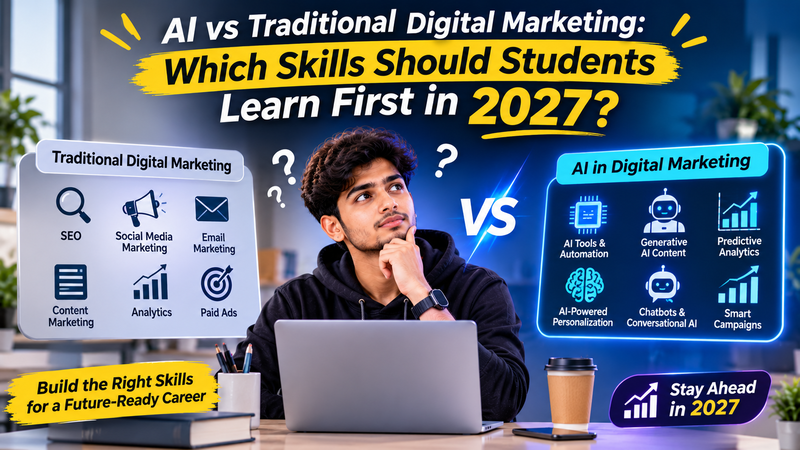
Artificial intelligence is changing the way businesses promote their products, reach customers, and manage online campaigns. Tasks that once required hours of manual work, such as content research, keyword analysis, advertisement creation, and marketing reports, can now be supported by AI-powered tools.
But does this mean traditional digital marketing skills are becoming less important?
Not at all.
Even in 2027, businesses need marketers who understand customers, create effective strategies, manage advertising campaigns, improve search visibility, and measure results. AI can make these activities faster, but it cannot replace the importance of marketing knowledge, creativity, and decision-making.
For students planning to enter this industry, the biggest question is: Should you learn AI marketing first or start with traditional digital marketing?
The answer is to understand both, but in the right order.
In this guide, we will compare AI and traditional digital marketing, explore the skills students should prioritize, and explain how to prepare for a successful digital marketing career in 2027.
What Is Traditional Digital Marketing?
Traditional digital marketing refers to promoting products and services through online channels using established marketing strategies, platforms, and techniques.
It focuses on understanding customer needs, reaching relevant audiences, creating useful content, and generating measurable business results.
Some important areas include:
Search Engine Optimization (SEO)
Social Media Marketing
Google Ads and paid advertising
Content Marketing
Email Marketing
Website Optimization
Affiliate Marketing
Performance Marketing
Google Analytics and reporting
For example, a digital marketer may research keywords, write a blog post, optimize a website page, manage an advertising campaign, and analyse its performance.
These activities require marketing knowledge, research skills, creativity, and practical experience.
What Is AI-Powered Digital Marketing?
AI-powered digital marketing uses artificial intelligence to support marketing activities, improve productivity, analyse information, and automate repetitive tasks.
Instead of completing every task manually, marketers can use AI tools to generate ideas, summarize data, create content drafts, and explore campaign opportunities.
Common applications include:
AI-assisted keyword research
Content ideas and blog outlines
Automated content suggestions
AI-powered image and video creation
Advertisement copy variations
Customer behaviour analysis
Marketing report summaries
Chatbots and customer support
Marketing workflow automation
Audience segmentation
For example, a marketer can use an AI tool to generate different advertisement headlines, review the suggestions, and select the most relevant version for a specific audience.
However, AI-generated information still requires human checking. Accuracy, brand voice, customer understanding, and marketing decisions remain important.
AI vs Traditional Digital Marketing: What Is the Difference?
Both approaches help businesses achieve marketing goals, but they differ in how certain tasks are performed.
1. Content Creation
Traditional approach: Marketers manually research topics, prepare outlines, write articles, and develop social media captions.
AI-powered approach: AI tools help generate content ideas, create initial drafts, suggest headlines, and improve existing text.
Which is better? Combining both approaches is more effective. AI can support content production, while human marketers ensure originality, accuracy, usefulness, and brand consistency.
2. Search Engine Optimization
Traditional approach: SEO professionals perform keyword research, website audits, competitor analysis, on-page optimization, and technical SEO checks.
AI-powered approach: AI can assist with keyword clustering, content analysis, research summaries, and identifying optimization opportunities.
Which is better? Students should first understand SEO fundamentals and then learn how AI can support their workflow.
3. Social Media Marketing
Traditional approach: Marketers plan content calendars, write captions, create creatives, publish posts, and monitor engagement.
AI-powered approach: AI helps generate content ideas, suggest captions, create visual concepts, and analyse audience feedback.
Which is better? AI can save time, but understanding audience interests and developing an effective social media strategy still require human judgement.
4. Advertising Campaigns
Traditional approach: Marketers research audiences, select keywords, develop ad copy, plan budgets, and monitor campaign performance.
AI-powered approach: Advertising platforms use machine learning and automation to support bidding, targeting, creative testing, and campaign optimization.
Which is better? Students should understand campaign objectives, targeting, budgeting, and advertising metrics before depending on automated features.
5. Data Analysis
Traditional approach: Marketers review reports, compare performance metrics, and manually identify opportunities for improvement.
AI-powered approach: AI tools can summarize reports, identify patterns, and assist with interpreting large amounts of marketing data.
Which is better? Learn how to read and understand data first. AI-generated insights are useful only when you can evaluate whether they make sense.
Which Skills Should Students Learn First in 2027?
If you are a beginner, learning AI tools before understanding marketing fundamentals can create confusion.
The best approach is to build your foundation first and gradually introduce AI into your workflow.
Here are the seven skill areas students should prioritize.
1. Learn Digital Marketing Fundamentals First
Before exploring advanced technology, understand how online marketing works.
You should know how businesses attract customers, communicate with audiences, and convert website visitors into leads or sales.
Start with:
Digital marketing channels
Target audience research
Customer behaviour
Marketing funnels
Competitor analysis
Brand positioning
Lead generation
Customer acquisition
Why is this important?
Without understanding marketing fundamentals, you may know how to use different tools but struggle to decide which strategy is suitable for a business.
Student practice task: Choose a local business and prepare a basic marketing strategy based on its target audience, competitors, and business goals.
2. Master SEO Before Depending on AI SEO Tools
SEO is an important skill for students because businesses need organic search visibility to attract relevant website visitors.
AI can help with research and content optimization, but you must understand the fundamentals behind search engine optimization.
Focus on learning:
Keyword research
Search intent
On-page SEO
Technical SEO
Off-page SEO
Local SEO
Internal linking
Website indexing
Google Search Console
Content optimization
After understanding these concepts, explore AI-assisted SEO tools for keyword clustering, content planning, and research.
Student practice task: Find 15 relevant keywords for a business and create an SEO content plan based on informational and commercial search intent.
3. Develop Content Writing and Creative Thinking
Content remains essential across search engines, social media platforms, email campaigns, and paid advertisements.
AI can generate drafts, but students should learn how to create content that answers customer questions and communicates clear messages.
Learn how to write:
SEO-friendly blog posts
Website landing pages
Social media captions
Advertisement headlines
Email marketing content
Product descriptions
Video scripts
Also develop storytelling, copywriting, editing, and research skills.
Student practice task: Write one educational blog post and three social media captions for the same business. Adjust the tone and message for each platform.
4. Learn Google Ads and Performance Marketing
Businesses use paid advertising to reach specific audiences, generate enquiries, and increase sales.
Students should understand how advertising platforms work before relying on automated campaign features.
Important skills include:
Google Ads campaign setup
Search advertising
Keyword targeting
Meta Ads management
Audience segmentation
Budget planning
Conversion tracking
Remarketing
Campaign optimization
Performance reporting
Understand key metrics such as CPC, CTR, CPL, CPA, and ROAS.
Student practice task: Prepare a sample advertising campaign with a target audience, keyword list, advertisement copy, budget, and performance measurement plan.
5. Learn AI Marketing Tools and Prompt Engineering
Once you understand the basics, start exploring AI-powered marketing tools.
A modern marketing course with AI should teach students how to use AI for practical marketing activities instead of simply introducing different software platforms.
Develop these skills:
Writing effective AI prompts
AI-assisted keyword research
Blog and social media content planning
Advertisement copy generation
AI image and video creation
Customer research assistance
Marketing report summarization
Workflow automation
Content review and fact-checking
You should also understand AI limitations, copyright considerations, privacy, and the importance of human review.
Student practice task: Use an AI tool to prepare a social media campaign. Generate ideas, review the suggestions, improve the captions, and create a final content plan.
The objective is to become a marketer who knows how to use AI effectively, not someone who depends entirely on generated content.
6. Understand Analytics and Data-Driven Marketing
One of the most valuable skills in modern marketing is understanding performance data.
A marketer should know whether a campaign is attracting the right audience and generating useful business results.
Learn these tools and concepts:
Google Analytics 4
Google Search Console
Google Tag Manager fundamentals
Website traffic analysis
Conversion tracking
Campaign performance reports
Audience engagement
Marketing dashboards
Key performance indicators
AI can help summarize reports, but you should understand the actual numbers and verify the conclusions.
Student practice task: Study a sample website analytics report and identify its main traffic sources, popular pages, and possible improvement areas.
7. Build Website and Marketing Automation Skills
Understanding website management and automation can help students work more effectively across different marketing activities.
Learn the basics of:
WordPress website management
Landing page optimization
Website structure
Mobile-friendly design
Conversion rate optimization
Email marketing
CRM fundamentals
Lead management
Automated follow-up workflows
These skills help you understand the complete customer journey, from discovering a business online to submitting an enquiry or making a purchase.
Student practice task: Create a sample landing page structure and design a simple lead follow-up workflow.
Traditional Marketing Skills vs AI Skills: What Should You Prioritize?
Students should not treat AI and traditional marketing as competing subjects. Both are valuable, but they serve different purposes.
Here is a practical way to prioritize your learning:
Learn first:
Marketing fundamentals
Customer research
SEO basics
Content writing
Social media strategy
Advertising fundamentals
Learn next:
AI prompt engineering
AI content assistance
AI creative tools
Marketing automation
Analytics and reporting
Develop continuously:
Strategic thinking
Communication
Creativity
Problem-solving
Campaign optimization
Customer understanding
This learning order helps you understand why a marketing activity is necessary before deciding how AI can make it more efficient.
How to Combine AI and Traditional Digital Marketing in Real Projects
The real advantage comes from combining both approaches.
Consider a practical example of a training institute that wants to increase student enquiries.
A marketer could follow this process:
Step 1: Research the audience
Understand students' interests, educational needs, and career goals.
Step 2: Perform keyword research
Identify relevant search terms related to courses, training, and career opportunities.
Step 3: Create useful content
Write informative website pages and blog posts that answer students' questions. Use AI for brainstorming and content planning where helpful.
Step 4: Improve social media presence
Develop educational posts, short videos, and student-focused content.
Step 5: Plan paid advertisements
Create suitable Google Ads and Meta Ads campaigns with clear objectives.
Step 6: Measure performance
Use analytics and campaign reports to understand traffic, enquiries, and conversions.
Step 7: Improve the strategy
Use the collected data to identify what is working and where improvements are needed.
This example shows why marketing knowledge and AI tools work best together.
How to Choose the Right Digital Marketing Course in 2027
If you are planning to join a digital marketing course in Jodhpur, look beyond the course title and advertised discounts.
The right training programme should help you understand traditional marketing techniques while preparing you for modern AI-powered workflows.
Before enrolling, check whether the syllabus includes:
SEO and keyword research
Google Ads and Meta Ads
Social media marketing
Content writing and copywriting
AI marketing tools
Prompt engineering
Website optimization
Google Analytics 4
Marketing automation
Practical projects and assignments
Portfolio development
When comparing a marketing course in Jodhpur, ask the institute whether students get opportunities to work on practical assignments and receive feedback from trainers.
Also check whether the training covers current marketing practices rather than focusing only on outdated techniques.
A good course should teach you how to plan campaigns, use tools, understand customer behaviour, and evaluate marketing results.
Career Opportunities After Learning AI and Digital Marketing
Combining marketing knowledge with AI skills can prepare students for several roles across the digital industry.
Some career options include:
SEO Executive: Works on keyword research, website optimization, content performance, and organic visibility.
Social Media Executive: Plans content, manages business profiles, and analyses social media engagement.
Performance Marketing Executive: Manages paid advertising campaigns, budgets, audience targeting, and conversions.
Content Marketing Executive: Creates blogs, website content, and marketing communication.
Digital Marketing Analyst: Studies campaign performance, website traffic, and marketing data.
AI Marketing Specialist: Uses AI-assisted workflows, content tools, automation, and data analysis to support marketing activities.
Freelance Digital Marketer: Provides digital marketing services to businesses and individual clients.
Remember that job opportunities depend on your practical skills, experience, communication, and ability to demonstrate your work. Learning a tool alone does not guarantee a job.
Frequently Asked Questions
1. Should students learn AI or traditional digital marketing first?
Students should learn traditional digital marketing fundamentals first, including SEO, customer research, content writing, social media, and advertising. After that, they should learn how AI can support these activities.
2. Is AI replacing traditional digital marketing?
No. AI is changing how marketing tasks are performed, but businesses still need people who understand customers, create strategies, evaluate data, and make informed decisions. AI is best treated as a productivity tool rather than a complete replacement for marketing knowledge.
3. Is a marketing course with AI useful for beginners?
Yes, provided it covers both marketing fundamentals and practical AI applications. Beginners should learn how to use AI for research, content development, advertising ideas, analytics, and automation.
4. What are the most important digital marketing skills in 2027?
SEO, performance marketing, social media management, content creation, AI-assisted marketing, website optimization, analytics, and marketing automation are valuable areas to develop.
5. Can I learn digital marketing without coding?
Yes. You can begin with SEO, social media, advertising, content writing, and analytics without advanced coding knowledge. Basic HTML and website knowledge can be useful as you progress.
6. How do I choose a digital marketing course in Jodhpur?
Compare the syllabus, practical training, trainer experience, AI tools, advertising modules, analytics training, and project opportunities. Choose a programme that helps you build demonstrable skills.
Final Thoughts: Become a Marketer Who Understands Both AI and Strategy
The future of digital marketing is not about choosing between AI and traditional marketing. It is about understanding how both approaches can work together.
Traditional marketing teaches you how to understand customers, develop strategies, create useful content, and generate business results. AI helps you research faster, explore ideas, automate repetitive activities, and improve productivity.
If you are a student preparing for 2027, start with the fundamentals and gradually develop your AI skills. Practise with real-world projects, build a portfolio, and keep learning as marketing platforms evolve.
Whether you are exploring a digital marketing course in Jodhpur, comparing a marketing course in Jodhpur, or searching for a marketing course with AI, prioritize practical training over simply learning software names.
The most valuable digital marketer in 2027 will be someone who combines human creativity, marketing knowledge, analytical thinking, and the effective use of AI.
Comments
No comments yet. Be the first to comment!