How Freshers Can Crack Digital Marketing Interviews in 2027
Learn how freshers can prepare for digital marketing job interviews in Jodhpur with practical SEO, Google Ads, AI, and portfolio-building skills.
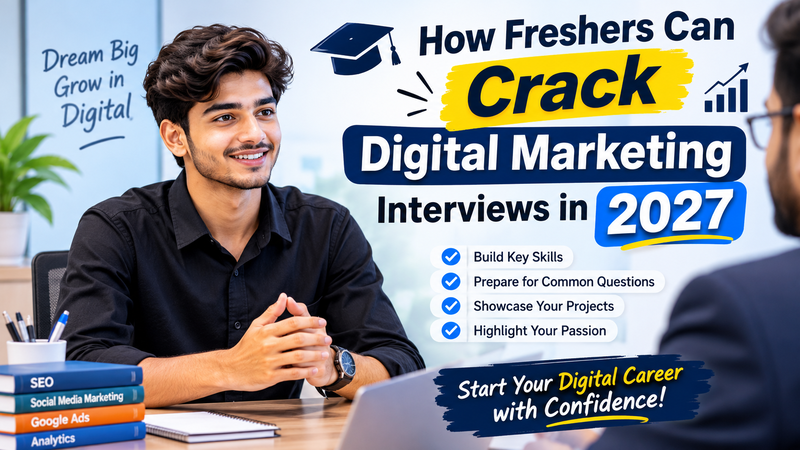
Getting your first digital marketing job can feel challenging when you have no professional experience. You may know SEO, social media marketing, Google Ads, and content creation, but how do you convince an employer that you are ready to work?
In 2027, having a digital marketing certificate alone may not be enough to impress recruiters. Companies want candidates who understand practical marketing activities, know how to use industry tools, solve basic business problems, and learn quickly.
The good news is that you do not need years of experience to make a strong impression. Even as a fresher, you can demonstrate your abilities through practical projects, a well-organised portfolio, and good interview preparation.
Whether you are a student, graduate, or job seeker, this guide explains how to prepare for digital marketing interviews and improve your chances of getting an entry-level job in Jodhpur.
1. Understand What a Digital Marketing Job Actually Involves
Before attending an interview, understand what digital marketers do in a professional environment.
Different companies have different requirements. A digital marketing agency may need someone to work on multiple client accounts, while an individual business may need support with its website, social media pages, and online advertisements.
As a fresher, you should understand common responsibilities such as:
Managing social media accounts.
Performing keyword research.
Writing SEO-friendly website content.
Preparing social media calendars.
Supporting Google Ads campaigns.
Monitoring website traffic.
Preparing marketing reports.
Analysing competitors.
Improving online brand visibility.
Try to understand how these activities contribute to business growth.
For example, a local clothing store may want more online enquiries. You should be able to suggest how Instagram content, local SEO, and targeted advertising could help the business reach potential customers.
Understanding practical business requirements makes your answers more convincing during interviews.
2. Prepare a Portfolio Before Applying for Jobs
One of the biggest problems freshers face is the lack of professional experience.
However, you can overcome this challenge by creating sample projects that demonstrate your knowledge.
A portfolio gives employers something specific to evaluate instead of relying only on your resume.
Consider including these projects:
SEO Website Analysis: Choose a sample website and identify opportunities for better keyword targeting, page titles, headings, internal linking, and content optimisation.
Social Media Campaign: Prepare a collection of Instagram posts, captions, and content ideas for a business.
Keyword Research Report: Find relevant keywords for a business and organise them according to search intent.
Google Ads Campaign Plan: Create a sample advertising campaign with suitable keywords, headlines, descriptions, and audience targeting.
Content Marketing Project: Write a blog article and prepare its SEO title, meta description, and internal linking suggestions.
Marketing Performance Report: Use sample data to explain traffic, clicks, engagement, and conversions.
Clearly mention whether these are practice projects or paid client projects. Honest presentation builds credibility.
3. Learn to Explain SEO With Practical Examples
SEO is one of the important areas you may encounter during a digital marketing interview.
Simply saying that SEO improves Google rankings will not demonstrate your practical understanding.
You should be prepared to explain how you would optimise a website.
For example, imagine a furniture business wants to attract customers searching for furniture in Jodhpur.
You could explain the following approach:
Research relevant keywords related to furniture products and services.
Understand what potential customers are searching for.
Optimise website titles, descriptions, headings, and content.
Improve internal linking between relevant pages.
Check website performance using Google Search Console.
Review indexing and technical SEO issues.
Monitor organic traffic and search performance.
You should also understand the difference between on-page SEO, off-page SEO, technical SEO, and local SEO.
Employers are more likely to appreciate practical explanations than memorised definitions.
4. Demonstrate Your Knowledge of Paid Advertising
Businesses use paid advertising to reach targeted audiences and generate enquiries.
Therefore, having basic knowledge of Google Ads and Meta Ads can strengthen your interview preparation.
Understand these important concepts:
Campaign objectives.
Keyword targeting.
Audience selection.
Ad copywriting.
Advertising budgets.
CPC and CTR.
Conversion tracking.
Landing page optimisation.
Campaign performance.
You may be asked a question such as:
"How would you generate leads for a coaching institute using Google Ads?"
A good answer would cover identifying relevant search keywords, selecting the appropriate campaign type, preparing compelling advertisements, creating a useful landing page, setting up conversion tracking, and monitoring lead quality.
You should understand the reasons behind each step rather than simply memorising the campaign process.
5. Show That You Know How to Use AI Marketing Tools
AI is becoming an important part of digital marketing workflows. Freshers who understand how to use AI tools responsibly can demonstrate additional value.
A modern marketing course with AI should help learners understand how artificial intelligence supports different marketing activities.
For interview preparation, practise using AI tools for:
Generating content ideas.
Creating social media captions.
Preparing blog outlines.
Researching potential keywords.
Developing advertising copy.
Creating content calendars.
Analysing marketing data.
Improving repetitive workflows.
However, do not tell an employer that you can simply generate everything using AI.
Explain how you review, edit, fact-check, and improve AI-generated content according to the brand's requirements.
For example, you can use ChatGPT to generate five advertising headlines, compare their messaging, and select the strongest options based on the campaign objective.
Your ability to combine AI assistance with human judgement is more important than knowing the names of several AI tools.
6. Improve Your Communication and Presentation Skills
Digital marketers regularly work with different people, including clients, managers, designers, and developers.
You may have good technical knowledge, but you should also be able to explain your ideas clearly.
Before attending an interview, practise answering questions such as:
Tell me about yourself.
Why did you choose digital marketing?
What is the difference between SEO and Google Ads?
How would you improve a business's social media presence?
Which digital marketing tools have you used?
How do you measure the success of a campaign?
What would you do if an advertising campaign generated clicks but no leads?
Try to answer in simple, professional language.
You do not need complicated vocabulary. Focus on explaining your thought process, giving relevant examples, and showing that you understand the question.
7. Understand the Difference Between Traffic, Leads, and Sales
A common mistake among beginners is assuming that more website traffic automatically means better business results.
Employers want digital marketers to understand that different campaigns have different objectives.
For example:
Traffic: Bringing relevant visitors to a website.
Leads: Encouraging potential customers to submit an enquiry or contact a business.
Conversions: Getting visitors to complete a desired action, such as making a purchase or booking a service.
Sales: Generating actual revenue through marketing activities.
You should understand how to connect campaign performance with business objectives.
For example, if a company receives 2,000 website visitors but only five enquiries, you should investigate the landing page, audience relevance, calls to action, and user experience.
This type of thinking can help you perform better in practical interviews.
8. Learn the Tools Used in Everyday Digital Marketing Work
Employers may not expect a fresher to be an expert in every marketing tool. However, basic familiarity with commonly used platforms can be helpful.
Here are some tools worth practising:
For SEO: Google Search Console, Google Keyword Planner, Semrush, and Ahrefs.
For Analytics: Google Analytics 4 and Google Looker Studio.
For Advertising: Google Ads and Meta Ads Manager.
For Content Creation: Canva and popular video editing tools.
For AI: ChatGPT and other AI-assisted content and research tools.
For Productivity: Google Sheets, Google Docs, and basic project management tools.
Do not try to learn every platform at once. Start with the tools relevant to your preferred career path and practise using them regularly.
9. Apply for the Right Entry-Level Positions
Freshers sometimes apply only for general digital marketing positions without considering other opportunities.
However, digital marketing includes several specialised career paths.
Depending on your skills, you can apply for:
Digital Marketing Trainee.
Digital Marketing Executive.
SEO Executive.
Social Media Executive.
Content Marketing Executive.
PPC Executive.
Junior Performance Marketing Executive.
Digital Marketing Intern.
Start with positions that match your current skills.
An internship or trainee position can provide useful exposure to client requirements, campaign management, teamwork, deadlines, and reporting.
As your knowledge improves, you can take on more specialised responsibilities.
10. Follow a 30-Day Preparation Plan Before Your First Interview
A structured preparation plan can help you become more confident and organised.
Here is a simple 30-day approach for aspiring digital marketers.
Days 1–7: Revise the Fundamentals
Study SEO, social media marketing, Google Ads, content marketing, and digital marketing terminology.
Days 8–14: Practise Marketing Tools
Work with Google Search Console, Google Analytics 4, Canva, Google Ads, and AI tools.
Days 15–21: Build Practical Projects
Create an SEO audit, keyword research report, social media calendar, and sample advertising campaign.
Days 22–25: Prepare Your Portfolio
Organise your best projects and explain the objective, process, and tools used for each one.
Days 26–30: Practise Interviews
Prepare answers to common questions, improve your communication, and practise presenting your projects.
By the end of this process, you should have practical work to discuss during interviews instead of relying only on theoretical knowledge.
11. How to Choose the Right Training for a Digital Marketing Career in Jodhpur
Learning independently can help you understand basic marketing concepts, but structured training may provide a more organised learning experience.
When comparing a digital marketing course in jodhpur, do not make your decision based only on the course duration or certificate.
Check whether the programme offers:
Practical SEO training.
Google Ads and Meta Ads learning.
Social media management.
Content writing and copywriting.
Website optimisation.
Analytics and reporting.
AI tools and automation.
Live projects and assignments.
Portfolio development.
Interview preparation and career guidance.
A suitable marketing course in jodhpur should help you understand how to apply your knowledge to real business requirements.
Look for opportunities to practise, ask questions, receive feedback, and work on different types of marketing projects.
At Inframe School, aspiring digital marketers can explore practical learning, mentorship, and industry-relevant digital marketing skills to build their foundation for professional opportunities.
The important thing is to choose training that encourages you to do actual work rather than simply memorise information.
12. Common Mistakes Freshers Should Avoid During Interviews
Even candidates with good knowledge sometimes make avoidable mistakes.
Keep these points in mind:
Only Talking About Certificates: Explain what you have learned and demonstrate it through projects.
Claiming Expertise in Every Tool: Be honest about your current skill level and show your willingness to learn.
Ignoring Business Objectives: Understand that marketing activities should support traffic, leads, sales, or brand awareness.
Depending Completely on AI: Use AI as an assistant, not as a replacement for marketing knowledge and independent thinking.
Having No Portfolio: Prepare sample projects even when you have never worked with a professional client.
Giving Memorised Answers: Use examples to show how you would handle practical marketing situations.
Avoiding these mistakes can help you appear more prepared and confident.
Conclusion
Standing out in a digital marketing job interview does not require years of professional experience. It requires preparation, practical knowledge, problem-solving ability, and the confidence to demonstrate what you have learned.
In 2027, freshers should focus on developing SEO, paid advertising, social media marketing, content creation, analytics, and AI-assisted marketing skills.
Build a portfolio, practise common interview questions, understand business goals, and learn how to explain your work clearly.
Whether you are preparing independently or joining a marketing course, remember that your practical abilities matter more than the number of certificates you collect.
A good marketing course with AI, combined with consistent practice and real-world assignments, can help you develop relevant skills and prepare for entry-level digital marketing opportunities in Jodhpur.
Start building your skills today, and make your first digital marketing interview an opportunity to show what you can actually do.
Comments
No comments yet. Be the first to comment!