Graphic Design Career in India: Myths vs. Facts
Thinking about a graphic design course in India? We bust common myths about pay, talent & institutes so you can choose the right path with confidence.
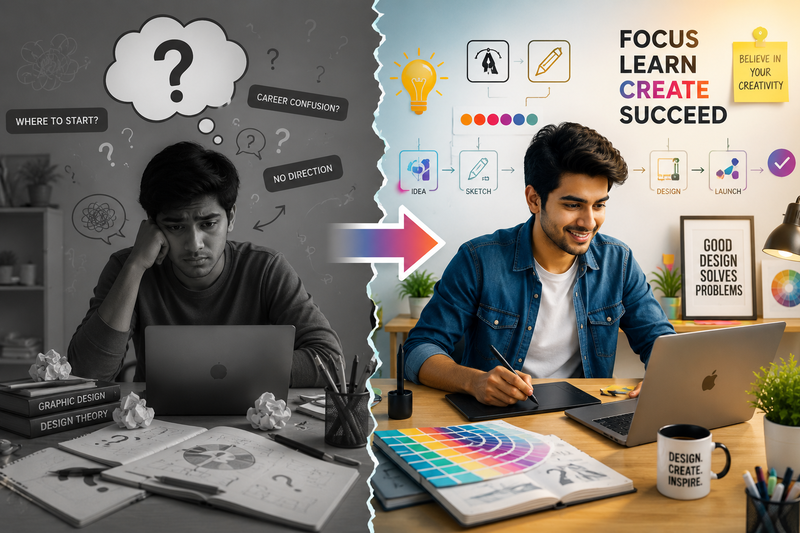
Ask around and you'll hear a dozen different opinions about design as a career — some outdated, some flat-out wrong. If you're considering a graphic design course but hesitating because of things you've heard, this article separates myth from reality so you can make an informed decision.
Myth 1: "You Need to Be a Natural Artist to Learn Design"
Reality: Graphic design is a learnable skill, not an inborn talent. While drawing ability can help in certain niches, most professional design work relies on principles you can study — typography, layout, color theory, and composition — not freehand illustration. A structured graphic design course teaches these principles systematically, so beginners with zero art background regularly go on to become skilled, employable designers.
Myth 2: "Any Graphic Design Institute Will Teach You the Same Thing"
Reality: Quality varies significantly between institutes. Some focus purely on software tutorials, while others build a complete foundation in design thinking, branding, and UI/UX alongside tool training. Before enrolling in any graphic design institute, check the syllabus depth, whether live projects are included, and whether faculty have real industry experience — not just teaching experience.
Myth 3: "Online Classes Aren't as Good as Classroom Training"
Reality: This used to be somewhat true, but it isn't anymore. Many graphic design classes delivered online now include live mentor sessions, real-time feedback, and project-based assignments that match — and sometimes exceed — traditional classroom quality. What actually matters is the structure and mentorship, not whether it happens in person or on a screen.
Myth 4: "Graphic Design Doesn't Pay Well in India"
Reality: Entry-level pay can be modest, similar to most creative fields, but it scales meaningfully with skill, specialization, and portfolio strength. Designers who build expertise in UI/UX, branding, or motion graphics — and who can show strong client or project outcomes — often earn significantly more, whether through agency roles, in-house positions, or freelance work. India's growing startup and D2C ecosystem has also increased demand (and budgets) for skilled designers.
Myth 5: "You Must Master Every Design Tool to Get Hired"
Reality: Depth matters more than breadth. Employers generally look for strong command of a few core tools relevant to the role — for example, Illustrator and Photoshop for branding work, or Figma for UI/UX — combined with solid design thinking. A good graphic design course in India will focus your learning on the tools most relevant to your chosen specialization, rather than spreading you thin across everything.
Myth 6: "A Certificate Guarantees a Job"
Reality: A certificate signals training, but your portfolio does the actual convincing. Employers and clients want to see real problem-solving — how you approached a brief, iterated on feedback, and delivered a polished result. This is why the best programs integrate portfolio-building throughout the course rather than treating it as a final formality.
What You Can Realistically Expect From a Good Design Program
Structured learning – fundamentals first, software second, real projects throughout
Mentorship – feedback from designers with actual industry experience, not just theoretical instructors
A specialization path – branding, UI/UX, print, or digital media, depending on your interest
A portfolio – tangible proof of your skills, built progressively over the course
Career guidance – placement support, internship connections, or freelance readiness
How to Separate a Good Program From an Average One
When comparing options, ask direct questions:
Do they show examples of past student portfolios?
Is the curriculum updated with current design and UI/UX trends?
Are class sizes small enough for individual feedback?
Do they offer both graphic design classes in person and flexible online options?
What kind of placement or internship support do they provide after the graphic design course?
Institutes that answer these clearly and confidently are usually the ones investing in genuine student outcomes, not just enrollment numbers.
Final Thoughts
Design as a career in India is more accessible — and more rewarding — than many of the myths suggest. What matters most isn't natural talent or which software you memorize first; it's choosing a graphic design course that builds real foundations, picking a graphic design institute with genuine mentorship, and staying consistent through practical, portfolio-building work. Whether you prefer in-person graphic design classes or a flexible online format, a well-informed start makes all the difference.
If you've been putting off your graphic design course in India search because of half-true assumptions, now is a good time to look past the myths and start with facts instead.
Comments
No comments yet. Be the first to comment!